Messi
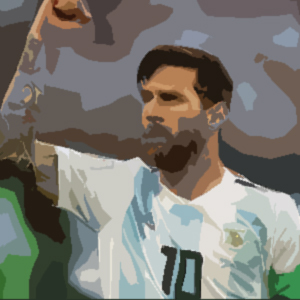
November 16, 2003 – In the opening match at the Estádio do Dragão in Porto, Lionel Messi made his first-team debut. Everyone at the club already knew that he was destined for success. But what had come before? How had he reached that point?
September 5, 2019
A computer science teacher described him as a child with little desire to learn. His French teacher said that he never participated in class. The cook at La Masia noticed that he was always the last to arrive for dinner. Verón recalled that, during the World Cup, Messi sometimes refused to get out of bed. Who would have imagined that this shy, seemingly lazy boy would one day achieve greatness?
As a child, Leo was diagnosed with growth hormone deficiency, a condition that restricted his growth. Much shorter than his peers, he was very withdrawn. At school, he was too shy to speak or buy food, so his girlfriend did it for him. Because of his communication difficulties and low self-esteem, a teacher referred him to a psychologist. His friends called him “Enano” (“Dwarf”), rather than “La Pulga” (“The Flea”). The cost of treatment stood between Leo and his dream of becoming a professional footballer. He needed daily growth hormone injections costing around $1,000 a month—more than half his father’s salary. A football academy in Spain offered a solution. Messi was so talented that FC Barcelona’s academy, La Masia, agreed to cover half the cost of his treatment. At 13, he boarded a plane for Europe.
Being separated from his family was difficult; an agent recalled that he could not stop crying. Sensitive off the pitch, he was fierce on it. Injuries were frequent. His physique was unusual for a footballer: broad hips, short arms, short stature, and a long torso, meaning that he required customized equipment. He could also be absent-minded: on one occasion, he locked himself in a toilet before a playoff; shortly after arriving in Barcelona, he broke his ankle on a staircase. A 2003 FC Barcelona report described Messi as both the most talented player and the soundest sleeper of his generation. One ritual has remained with him since childhood: after each training session, he takes a nap lasting around three hours.
His fame could also expose him to danger. In his hometown of Rosario, he remained a potential target for fanatics. In 2011, a Rosario Central supporter punched him as he left a restaurant. Before a Clásico against Real Madrid, someone opened fire on his older brother’s house. Media outlets speculated that the attack was intended to unsettle Leo before the match. Matías Messi avoided cameras, saying that appearing on television or in photographs would be too dangerous.
April 18, 2007 – In the Copa del Rey semifinal, Messi scored a goal that broke YouTube viewing records and drew comparisons with one scored by his childhood idol, Diego Maradona.
December 21, 2009, Zurich – FIFA named Messi the world’s best footballer with the highest score in the award’s history. Over the following two years, he won two more Ballon d’Or trophies.
March 20, 2012 – In a league match against Granada, Messi scored a hat-trick and became FC Barcelona’s all-time leading scorer.
At the time of writing, Messi was earning more than €100 million a year from football. He had become a role model and a source of inspiration for many people. His journey—from a fragile boy from a poor family who faced health problems and low self-esteem to one of the world’s most successful footballers—gave people hope. He also became a devoted father of three sons. Was the long struggle worth it? The answer seems obvious.
This article is based on the book “Messi” by Leonardo Faccio.
SEO Keywords: Lionel Messi, motivation, football legend, inspiring stories, growth hormone deficiency, Ballon d’Or, football history, success story, mental strength, childhood and football, La Masia, Rosario, FC Barcelona, hat-trick, health and sports, self-overcoming, role model