Jude Bellingham: Mental Strength and Success
September 7, 2023
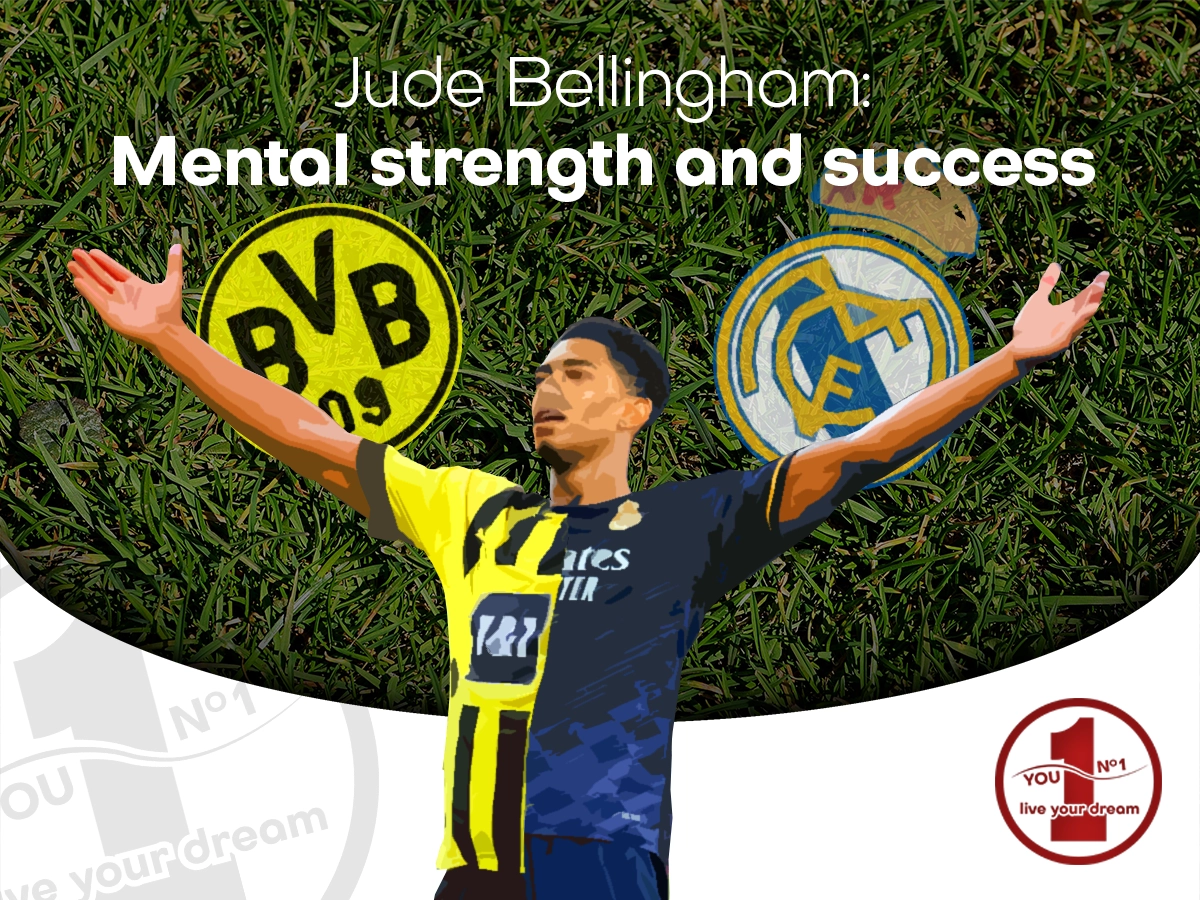
Jude Bellingham deserves more credit for Borussia Dortmund’s achievements in the 2022/23 season than some media commentators have given him. After his departure, Dortmund appeared to miss not only his footballing quality but, above all, his mental strength. Taking only five points from three matches against comparatively weak opposition suggested that replacing him would be more difficult than many had assumed. He was arguably Dortmund’s mentally strongest leader in 2022/23, and his influence was evident both in training and during matches. It is reasonable to ask whether, had he played in Dortmund’s final match against 1. FSV Mainz 05, the team might have won and become German champions. Bellingham also demonstrated his mental strength and footballing ability for England. Few people expected him to settle so quickly into Real Madrid’s successful team. Carlo Ancelotti, one of the world’s leading coaches, deserves some credit: he not only recruited Bellingham but also found the position in which he could perform at his best.
The decisions of even highly respected coaches can sometimes be puzzling. They may overlook the fact that one poorly filled position can reduce a team’s effective potential by roughly 9 percent—the share represented by one player in an 11-man side. The impact may be even greater when the position is goalkeeper or defender. A coach’s response to repeated mistakes also matters. Errors are part of football, but a player who gives the ball to an opponent five times in quick succession, repeatedly arrives too late in defense and merely chases opposing attackers, or ignores a better-positioned teammate on five clear scoring opportunities cannot be treated as though nothing has happened. When a coach accepts such error-filled play, it works against the development of a culture built around players with a winning mentality. But how did Bellingham develop such mental strength, and how does he summon it in almost every match? Only he could answer that directly. One may nevertheless assume that a team without mentally strong players who possess a winning mentality will struggle to achieve major success. At the time of writing, Manchester City stood out for the number of such personalities in its squad. That strength was reflected in the titles the club won in 2023, including the UEFA Champions League.
How did Messi, Cristiano Ronaldo, and Robert Lewandowski—and before them Pelé and Maradona—combine exceptional footballing ability with the mental strength required to become absolute leaders? One possible, simplified answer is that a player can think responsibly and creatively during a match only when his physical preparation allows him to sustain a high level of concentration throughout it.
Football clubs sometimes appear to devote too little attention to young players’ mental development. Even established clubs may not use psychophysical training sufficiently, despite its potential contribution to building and preserving mental strength. Practices such as visualization and breathing exercises can be developed individually through disciplines including yoga and tai chi. More players—including Müller, Haaland, and Götze—have incorporated yoga into their routines and emphasized its benefits for fitness and recovery. Mario Götze’s career is instructive. After scoring the winning goal in the 2014 World Cup final between Germany and Argentina, health problems appeared to threaten his career. He nevertheless returned to form with the help of training that included elements of yoga. Those responsible for training methods should therefore consider whether athletes’ psychophysical performance could be supported by specialists such as Yasin Seiwasser, who teaches how to remain calm under pressure according to the principle: “Only calmness under stress is true calmness.”