
Doppelpass, foul interpretation and player protection in professional football
A replay shows the contact. Then the discussion begins: who established their position first, how was the ball protected, and what risk did the opponent face?
23.12.2025 / 27.10.2026
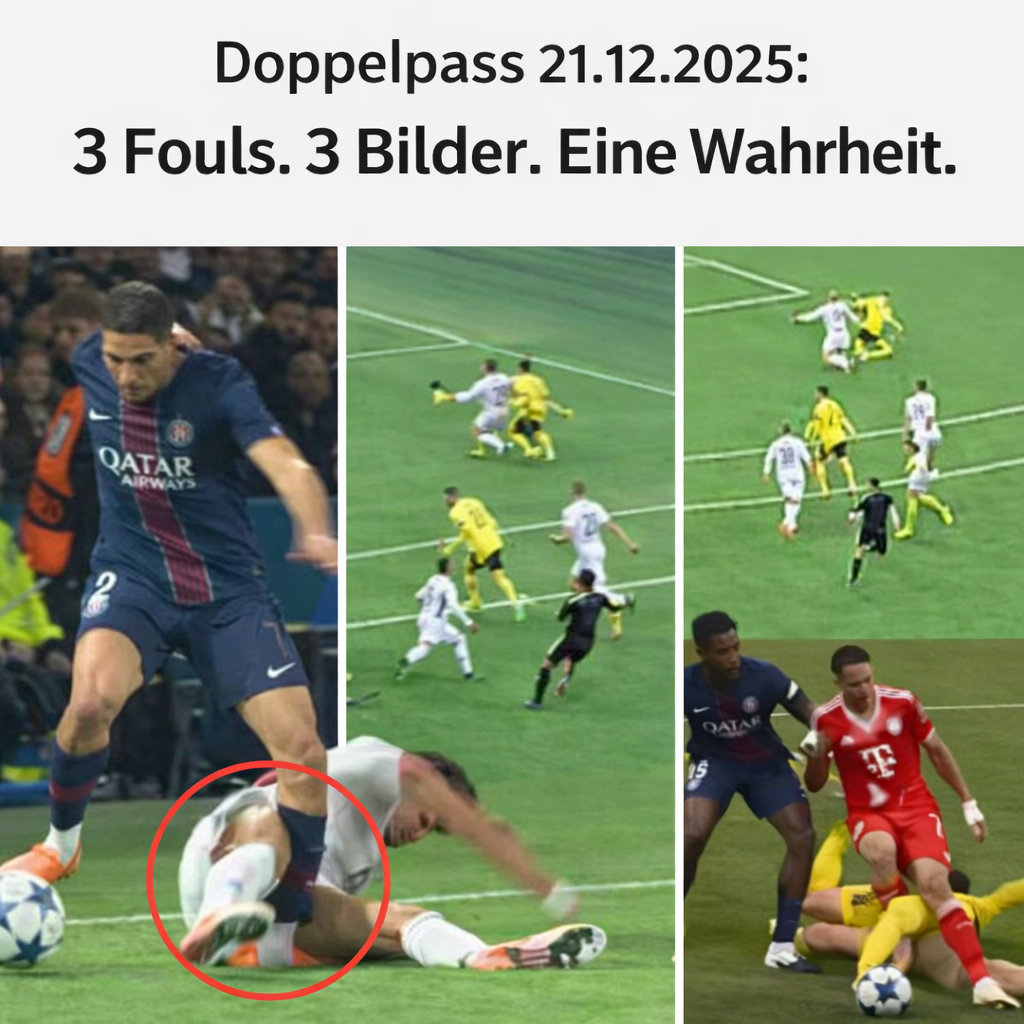
How should a challenge be assessed so that player protection is part of the judgement?
A replay shows the contact. Then the discussion begins: who established their position first, how was the ball protected, and what risk did the opponent face?
Using three incidents discussed on Doppelpass, YouNr1 takes a clear position in favour of protecting dribblers and players in possession. The assessment connects observations of the weight-bearing foot with the criteria in Law 12.
Doppelpass, 21 December 2025: three fouls. Three images. One truth.
On Doppelpass, the interpretation of fouls and player protection in professional football
I am a great fan of Doppelpass. In my view, it is one of Germany’s most interesting football television programmes, regularly offering a broad and nuanced discussion of the German game. The latest programme, however, also examined a situation that, in our view, touches on a fundamental and highly relevant issue: a straightforward foul on Beier of Borussia Dortmund inside the penalty area.
Of the six participants in the studio discussion, only one agreed with us and clearly recognised the kick on Beier inside the area as a foul. This is about more than an isolated incident. It concerns the basic standards governing challenges in football, standards that apply to virtually every playing situation:
- every one-on-one contest;
- every dribble;
- every reception of the ball;
- every change of direction with the ball.
The correct interpretation by referees is crucial because players’ health depends directly on it. The fouls on Musiala and Hakimi illustrate how dangerous a mistaken assessment of such situations can be.
What do the three situations have in common?
In brief, the opponent does not strike the ball but the ball carrier’s foot, which is already planted on the ground. Whether the player is deliberately shielding the ball should make no difference. An important starting point for our analysis is this: who places their foot in that position first? A complete assessment under the Laws of the Game must also consider the nature, intensity and consequences of the challenge.
1. Bayern Munich–Paris Saint-Germain: the foul on Hakimi
In the match between Bayern Munich and Paris Saint-Germain, Luis Díaz fouled Hakimi. Hakimi runs past his opponent with the ball. As he carries it, he keeps his left foot on the ground a moment longer to protect the ball. At precisely that moment, he is struck in the leg from behind.
Two points matter here:
- The incident took place roughly in midfield.
- Hakimi could reasonably expect not to face such a foul there.
We can assume that Hakimi would have behaved differently closer to the penalty area — more cautiously, in the sense that he would have been more likely to anticipate such an attack on his foot.
2. Borussia Dortmund–Borussia Mönchengladbach: the foul on Beier in the penalty area
In the match against Borussia Mönchengladbach, Beier is fouled inside the penalty area. In a one-on-one situation, he controls the ball and runs to the right. While running, he is struck on the left foot.
The decisive points are:
- Beier is the player who places his foot on the ground first.
- Whether he intended to shield the ball is irrelevant to that assessment.
A player struck on a weight-bearing standing leg can lose balance and fall. Particularly when the entire body weight rests on that leg, we believe such contact deserves special attention in protecting players — as in the situations involving Musiala and Hakimi discussed here.
3. Musiala: dribbling, playing style and Donnarumma’s foul
Before discussing the foul, a brief word about Musiala’s distinctive style of play.
From our article of 24 September 2021:
“One particularly striking feature of his game is his ability to dribble with exceptional efficiency at high speed. He always looks for the shortest route to his goal, often carrying the ball almost straight ahead without detours. His dribbling technique recalls the greatest players in football history, such as Pelé, Maradona and Messi. The comparison concerns his dribbling skills alone.”
Musiala’s dribbling is characterised by the way he positions his feet as he runs with the ball, keeping it protected. Mentally, he is always one step ahead of his opponent. This very style of play also led to the dangerous incident in the Bayern–PSG match in which he sustained several foot injuries.
This was not a conventional “football incident”, comparable to a Formula One “racing incident” where no one is clearly at fault. Both players were almost at the ball simultaneously, but Donnarumma drives into both of Musiala’s feet to reach it. In other words, the goalkeeper puts his body in a position to reach the ball at the same time or fractionally earlier while, in our view, endangering his opponent’s safety. And that is exactly what happened.
Conclusion: the refereeing standard
Our assessment remains unchanged: protecting the weight-bearing foot deserves particular weight when judging a foul, even when the ball carrier is shielding the ball. Law 12 requires the whole action to be assessed and distinguishes, in particular, between careless challenges, reckless challenges and those using excessive force. Contact with the ball and the position of the foot therefore belong in the analysis alongside the nature and intensity of the contact.
Keywords: Doppelpass football analysis; interpretation of fouls in the penalty area; player protection in professional football; assessing one-on-one challenges; refereeing standards and player health.